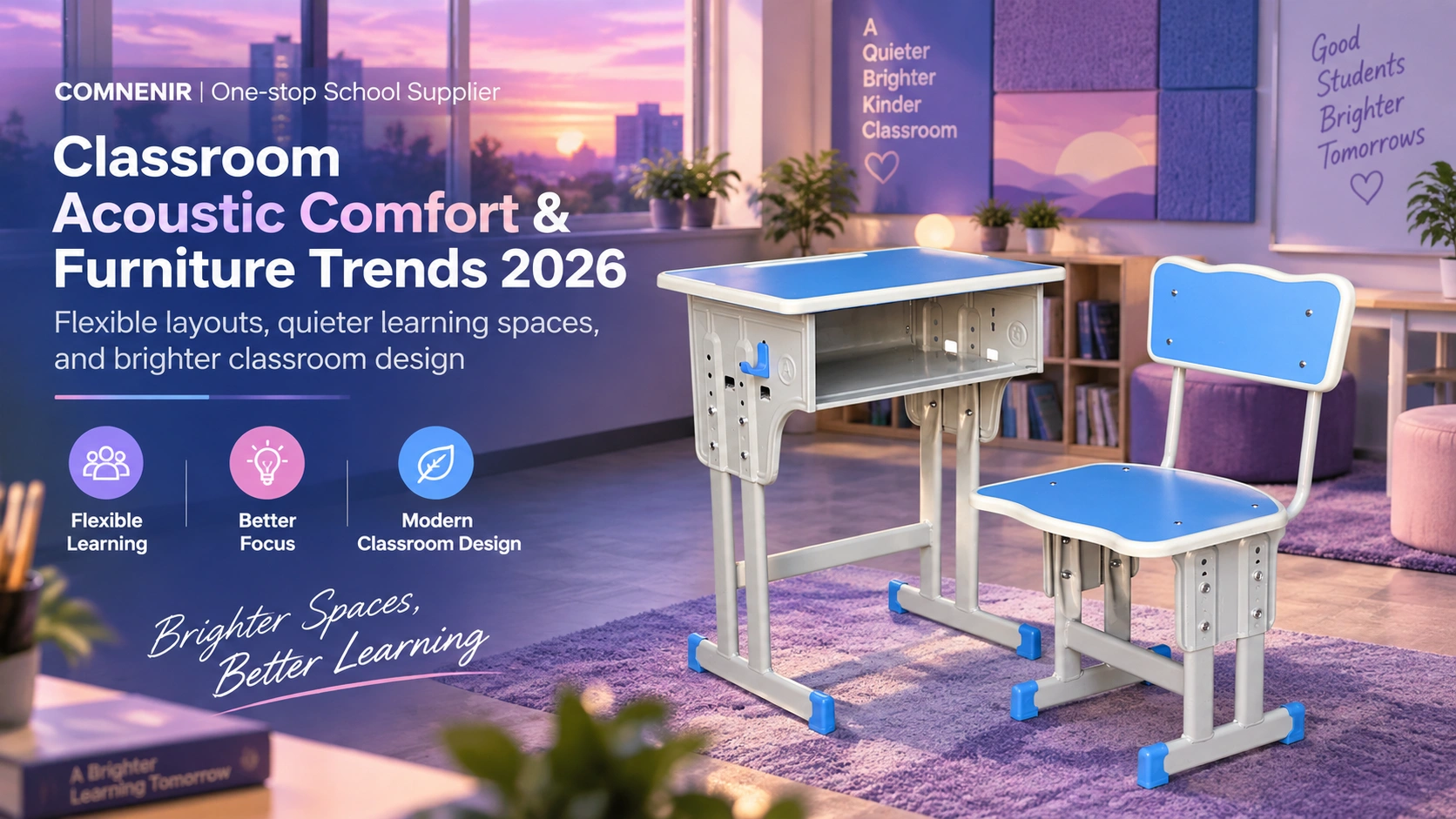
Modern classrooms are becoming more active.
Students may move between teacher-led instruction, group discussion, collaborative projects, presentations, digital learning, and independent study during the same lesson.
While this flexibility creates new learning opportunities, it can also make classroom noise management more important.
In 2026, schools and education designers are paying increasing attention to acoustic comfort as part of the overall learning environment.
Recent classroom-acoustics guidance highlights reverberation, background noise, mechanical equipment noise, and sound isolation as important factors in classroom acoustic performance. Metropolitan Acoustics
For school furniture buyers and project contractors, this means that furniture selection and classroom layout should increasingly be considered together with the acoustic design of the space.
Why Classroom Acoustics Matter
A classroom must allow teachers and students to communicate clearly.
If sound reflects too strongly from walls, ceilings, floors, and other hard surfaces, the room can become uncomfortable and speech may become more difficult to understand.
The ANSI/ASA S12.60 standard is one commonly referenced framework for classroom acoustic performance, covering factors such as background sound levels, reverberation time, and sound isolation. Metropolitan Acoustics
For schools, good acoustic planning is therefore not simply about making a classroom quieter.
It is about creating an environment where communication, concentration, and different learning activities can take place more effectively.
Furniture Can Support Better Learning-Space Design
Furniture alone cannot solve every acoustic problem.
However, the way furniture is selected and arranged can support a broader acoustic strategy.
For example, schools may consider:
– Soft seating in reading or discussion areas
– Mobile partitions between activity zones
– Flexible furniture layouts
– Bookcases or storage units used to organize space
– Collaborative tables separated from quiet study areas
– Furniture that can be repositioned according to classroom activity
Current 2026 education-space design discussions increasingly emphasize environments that combine ergonomics, acoustics, flexibility, and student comfort rather than treating furniture as an isolated product category. actiu.com
Flexible Classrooms Need Different Acoustic Zones
Modern classrooms are often designed for multiple functions.
A single room may be used for:
– Lectures
– Group discussions
– Individual study
– STEAM activities
– Presentations
– Digital learning
– Reading
Industry coverage in 2026 describes the classroom as an increasingly multipurpose environment, with folding tables, mobile seating, modular furniture, and adaptable layouts becoming more common. Mirplay School
This flexibility makes zoning more important.
For example, a collaborative area may need to support active discussion, while another part of the classroom may be designed for quiet reading or individual work.
Furniture can help define these different functional zones without requiring permanent construction.
Mobile Partitions and Storage Can Improve Space Organization
For larger classrooms, libraries, training rooms, and multipurpose learning spaces, movable elements can be especially useful.
Examples include:
– Mobile storage cabinets
– Bookshelves
– Movable partitions
– Modular seating
– Mobile tables
– Flexible discussion furniture
These products allow schools to reorganize the room when teaching activities change.
This is consistent with the broader 2026 trend toward classrooms that can quickly move between individual and collaborative learning configurations. Mirplay School
Acoustic Comfort Should Be Considered Early
One common mistake in school projects is to think about acoustics only after the classroom has been completed.
For new school construction and renovation projects, acoustic requirements are easier to manage when they are considered together with:
– Furniture layout
– Ceiling design
– Flooring
– Wall materials
– HVAC systems
– Classroom technology
– Lighting
– Storage
This integrated approach can help schools create classrooms that are not only visually modern but also more practical for daily teaching.
COMNENIR Learning-Space Solutions
COMNENIR provides furniture solutions for different school environments, including:
– Student desks and chairs
– Collaborative learning tables
– Mobile training furniture
– Library furniture
– Storage cabinets
– Teacher furniture
– Laboratory furniture
– Smart podiums
– Interactive flat panels
– Complete school furniture solutions
For international school projects, products can be customized according to classroom size, student age, teaching style, technical specifications, and tender requirements.
As education spaces continue to evolve, classroom design is becoming more integrated.
Furniture, acoustics, flexibility, technology, and student comfort are increasingly being considered together when creating modern learning environments.

Комплексные поставки школьной мебели
Наши товары и услуги
Школьная мебель для вашего проекта
 Русский
 English