
A student sits down, places a notebook on the desk and reaches for a textbook stored underneath. Before the lesson begins, several small details are already shaping the experience: the space for their legs, the position of the writing surface, the feel of the seat and the ease of reaching their materials.
These everyday interactions deserve attention when schools choose classroom furniture.
In September 2026, UNESCO published *Teaching with Care*, a guide developed jointly with UNICEF and WHO to help teachers create safe, inclusive and supportive learning environments. Its emphasis on everyday classroom practice provides a timely reminder that students experience school through many connected details. [Read about the guide](https://www.unesco.org/en/articles/teaching-care-practical-guide-teachers-support-mental-health-and-well-being-schools)
Furniture selection is one practical part of that wider environment. For schools, distributors and education project contractors, choosing school desks and chairs begins with understanding how students will actually use them.
## Begin with a Real Classroom Task
A showroom visit reveals colours, finishes and construction. A classroom trial reveals how the furniture works during a lesson.
Ask students to open a textbook, write in an exercise book, place materials in the storage compartment and move into and out of the seat. Invite teachers to observe whether the furniture accommodates these tasks without repeated repositioning or obstruction.
Student feedback can be specific and useful: the seat feels too deep, the desk is difficult to reach, or a storage compartment leaves too little room below the desktop. Recording these observations gives buyers a stronger basis for selection than appearance alone.
## Review the Desk and Chair as a Pair
A comfortable-looking chair may still be unsuitable when paired with a desk of the wrong height. Compare seat height, seat depth, desk height and clearance together.
Check that representative users can sit with their feet supported and work without having to reach excessively toward the desktop. Where the model offers height adjustment, confirm the available settings and how staff should secure them.
For projects covering several age groups, consider whether different furniture sizes are needed. A consistent design can be supplied in different specifications where available; a single size should not be selected simply to simplify the purchase order.
## Look Beyond the Presence of a Seat Pad
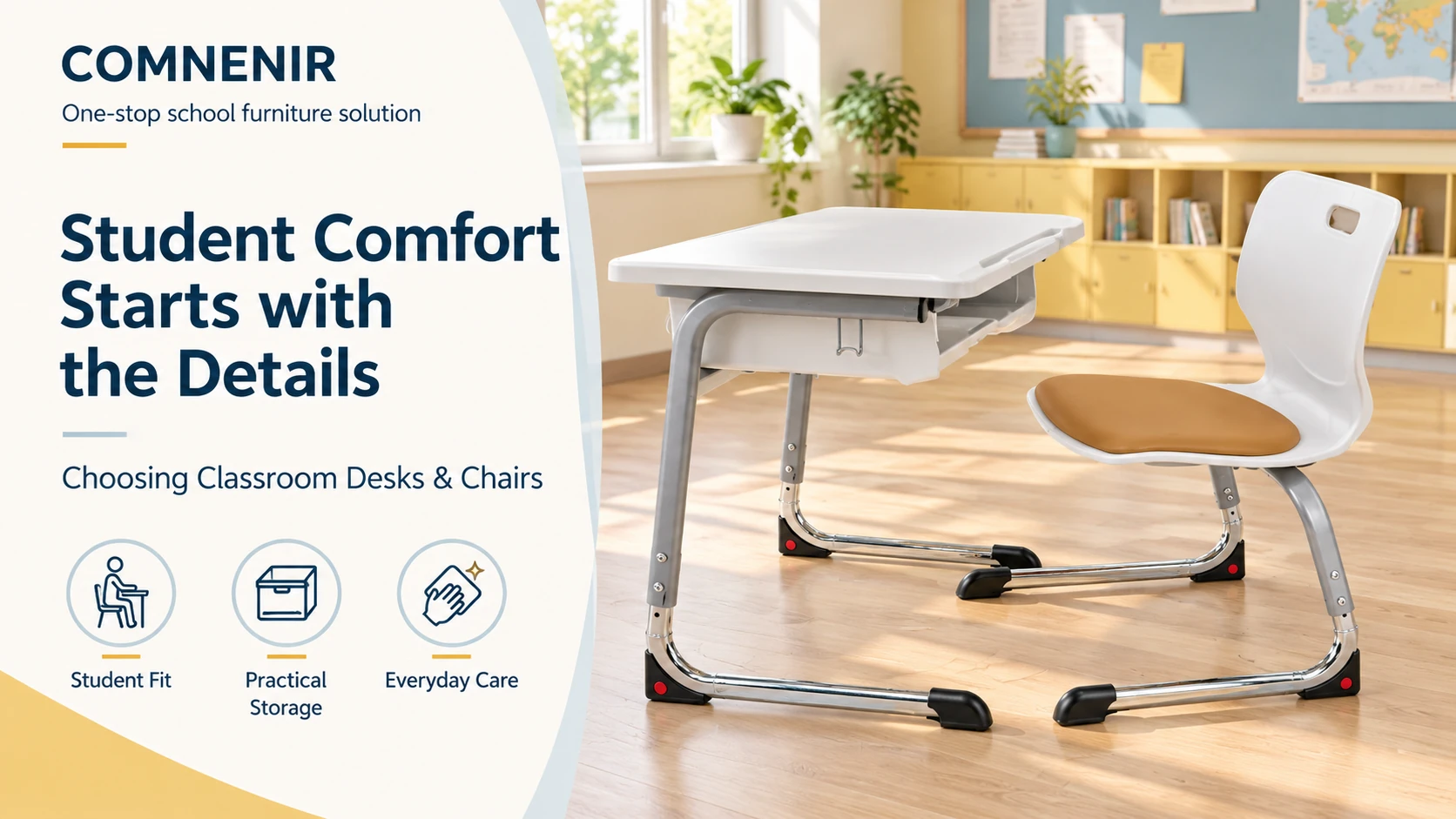
The COMNENIR desk and chair set pictured here combines a pale desktop, underdesk storage, a white contoured chair shell and a tan seat pad, with grey and chrome-finish tubular frames.
A seat pad is a visible design feature, but its suitability should be evaluated in use. Ask about the pad material, attachment method, cleaning requirements and replacement options. Review how its shape works with the seat and backrest for the intended students.
These details are particularly useful when comparing padded classroom chairs with unpadded alternatives. The right choice depends on the users, maintenance arrangements and project specification.
## Make Storage Convenient Without Restricting Movement
Underdesk storage can provide a place for books and stationery while leaving the writing surface available for classwork. Its usefulness depends on access and clearance.
Test the compartment with the books students normally carry. Check whether materials can be retrieved easily and whether stored items interfere with knees or movement. If hooks are included, review their position with the bags students are expected to use.
Plan additional classroom storage where necessary. Loading every personal item onto the desk can make circulation and everyday use more difficult.
## Consider Cleaning and Floor Contact
School furniture needs care throughout the term. Request cleaning instructions for the desktop, chair shell, seat pad and frame, including any restrictions on cleaning products.
Inspect foot caps and the points where the frame contacts the floor. Confirm the availability of replacement components and assess the sample on the type of flooring used in the destination school.
Agree on a practical inspection routine for loose fittings, damaged surfaces and worn parts. Clear maintenance instructions help school staff respond consistently when attention is needed.
## Give Buyers a Specification They Can Verify
A useful school furniture quotation should identify the desk and chair configuration, dimensions, materials, finishes and included components. Where testing documentation is required, confirm that it covers the selected model and specification.
For overseas orders, also establish packing dimensions, assembly requirements, spare parts, delivery terms and the production schedule. Keep the approved sample details alongside the purchase specification so that production and receiving teams work from the same information.
COMNENIR — One-stop school furniture solution — is a China-based school furniture manufacturer with a monthly production capacity of 20,000 sets. Share your student age groups, quantities, destination and classroom requirements to request a product proposal and quotation.
The most useful furniture decisions begin with the students who will sit at the desks every day. Testing the details before ordering helps buyers select school desks and chairs that fit the classroom’s actual routines.

 Русский
 English