
During the same lesson, one student may need another example, another may be ready for an extension task, and a third may benefit from discussing an answer with a partner. A classroom has to accommodate these differences while keeping everyday teaching practical.
This is a timely issue. On October 15, 2026, UNESCO reported on its ERCE Schools work in the Dominican Republic, where workshops focused on turning assessment results into teaching decisions and support tailored to students’ learning needs. The emphasis was on using evidence to decide what help learners need next. Read UNESCO’s report
For school leaders and furniture buyers, there is a practical planning question alongside that teaching work: can the room accommodate individual tasks, teacher feedback and purposeful peer discussion?
Individual school desks provide a defined workspace for each learner. Choosing and arranging them around classroom routines can help schools prepare for different activities without assuming that every student must work in exactly the same way throughout a lesson.
Give Each Learner a Usable Starting Point
A short individual task can help a teacher see what students understand before deciding how to continue. Learners need enough space to read the question, work through an answer and keep relevant materials nearby.
When evaluating a single student desk, try it with the books, worksheets and writing materials used in the intended class. Check the usable tabletop area rather than relying on overall dimensions alone. Molded edges, pencil grooves and cup recesses affect how that space is organized.
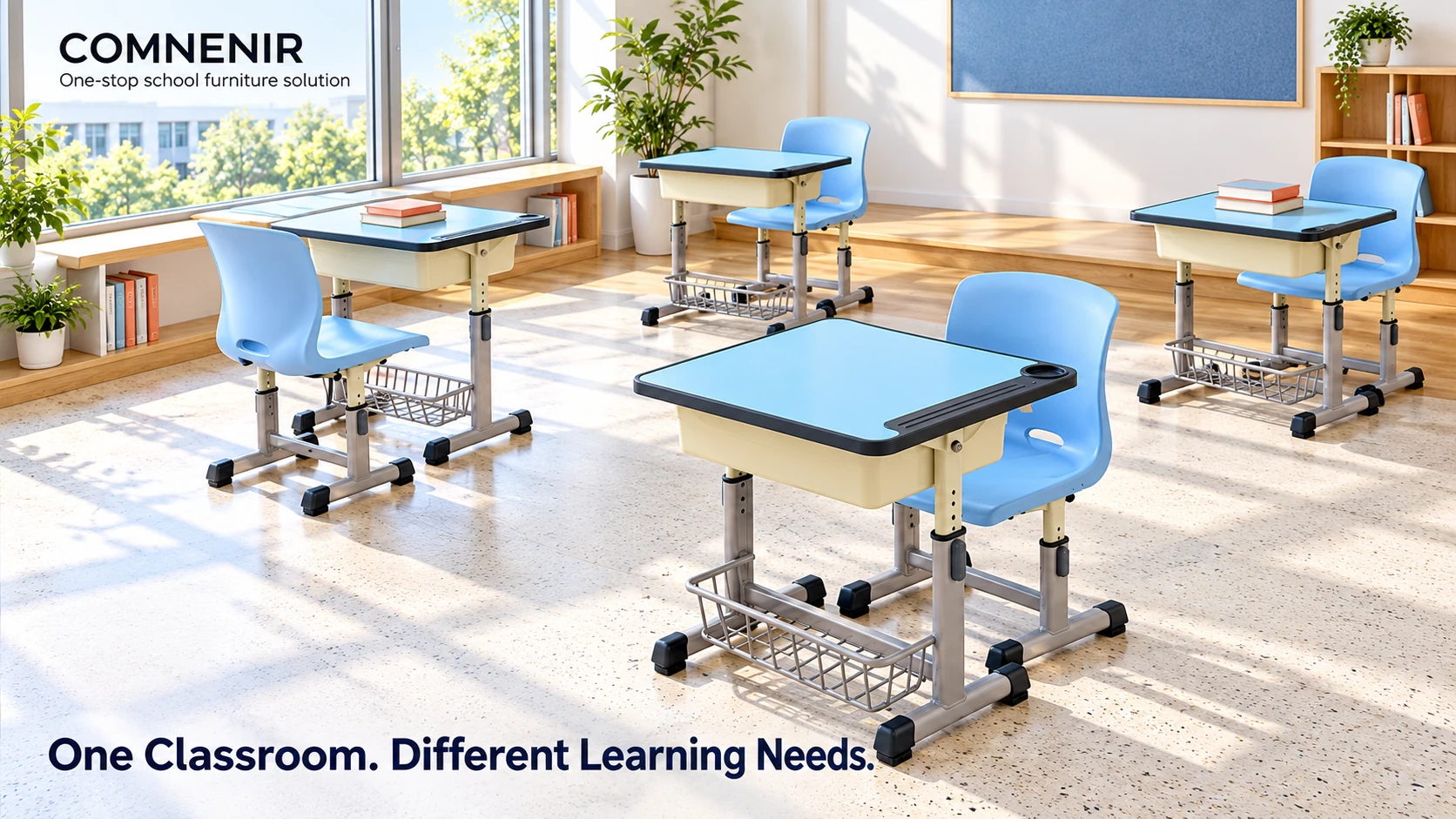
The COMNENIR set pictured here features a blue desktop with black edging, a cream underdesk compartment, a low metal basket and a matching blue chair. These features should be reviewed together with the model’s dimensions and intended student sizes.
Make Teacher Feedback Easy to Deliver
Different tasks often create different questions. A teacher may need to stop beside a student, examine written work or briefly explain a method.
Plan circulation around occupied chairs, not just empty desks. Check whether the teacher can reach students throughout the room without repeatedly asking others to stand or move their belongings.
Review sightlines as well. Students should be able to see the teaching area from their assigned positions, and the teacher needs a practical view of the class. A layout that looks orderly on paper still needs to work during a real lesson.
Plan Peer Discussion Without Constant Rearrangement
Individual desks can be placed beside one another for selected paired activities, provided the room layout and furniture dimensions allow it. Students might compare methods after answering independently or explain why they chose different responses.
Test whether partners can see shared materials comfortably while retaining their own writing space. Some activities may work with desks already positioned in pairs; others may be better served by a separate group-work area.
Avoid making every lesson depend on moving furniture. Where movement is needed, assess the desk’s weight, handling method, floor contact and school procedures before adopting a routine.
Organize Materials for Different Tasks
When learners use different worksheets or books, clear material routines become useful. Decide what belongs on the desktop, what can be stored underneath and what should remain in shared classroom storage.
Test the underdesk compartment and basket with actual materials. Confirm their intended use and load limits with the supplier. Keep stored items within the furniture’s footprint so they do not obstruct movement.
A practical arrangement gives students access to what they need while leaving the writing surface available for the current task.
Match Furniture Size to the Students
Different learning needs and different physical requirements both deserve attention. Confirm desk height, chair height, seat dimensions and leg clearance for the intended users.
For adjustable school desks and chairs, request the available settings and adjustment instructions. Establish who will make changes and how settings will be checked during use. Include accessible seating and any individual support requirements in the wider classroom plan.
A consistent furniture design can create a coordinated appearance while allowing different sizes or configurations where needed.
Specify the Classroom Routine Before Ordering
Schools, distributors and project contractors can make an inquiry more useful by describing how the room will function. Share the student age range, class size, typical learning materials and the balance between independent work, paired activities and teacher-led instruction.
Include a room layout where available, and confirm whether each quoted set includes one desk and one chair. Agree on dimensions, materials, storage components, documentation and delivery requirements before finalizing the order.
COMNENIR — One-stop school furniture solution — is a China-based school furniture manufacturer with a monthly production capacity of 20,000 sets. Send your classroom requirements, quantities and destination to request a product proposal and quotation.
Teaching decisions respond to students’ progress. A thoughtfully planned classroom gives those decisions a practical place to happen, with individual workspaces, reachable learners and room for different activities throughout the school day.

 Русский
 English