
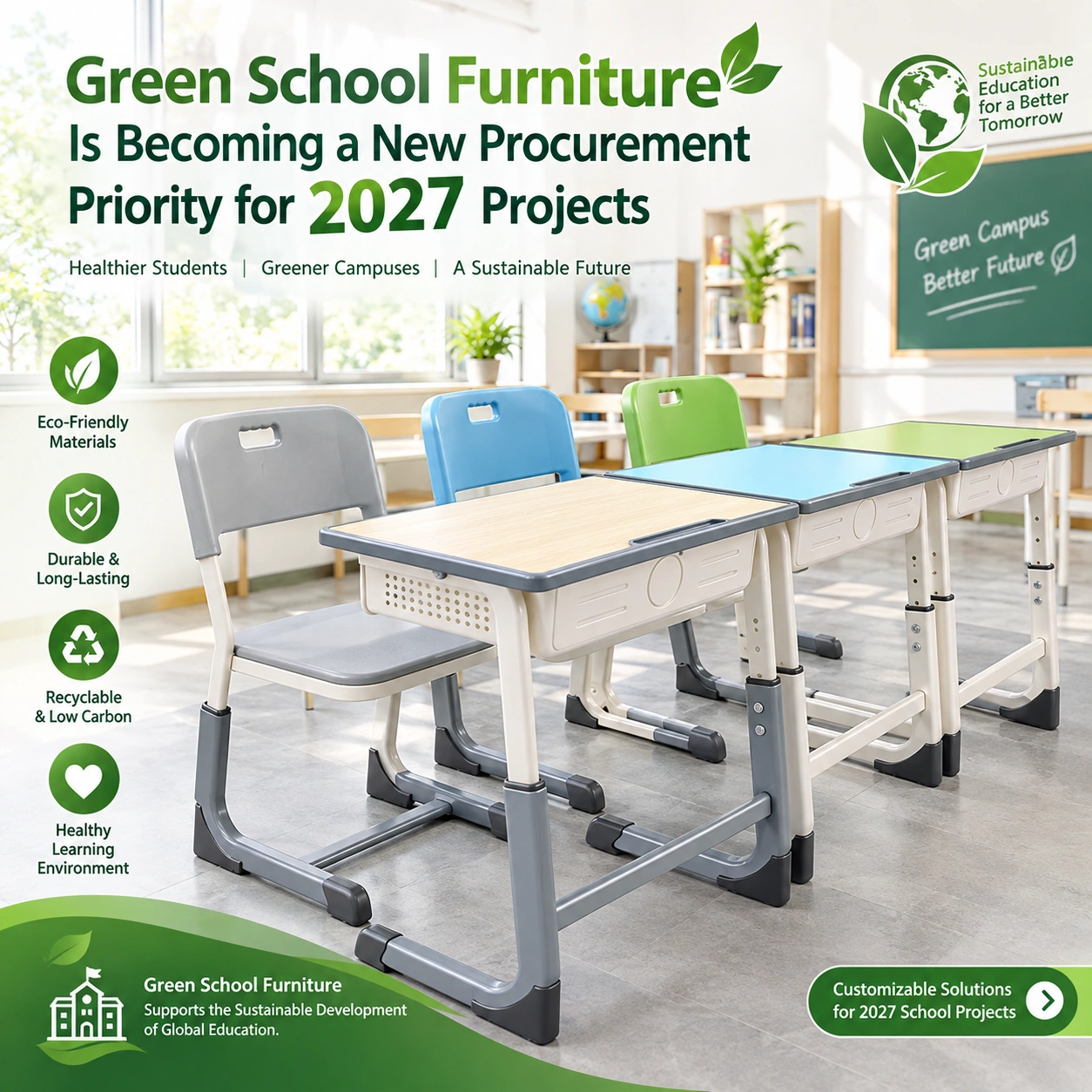
School furniture procurement is entering a new stage.
For many years, buyers mainly focused on three factors: price, durability, and delivery time. In 2026, however, sustainability is becoming a more visible requirement in education projects.
A recent Malaysian tender for classroom furniture for the 2027 school year specifically identified the procurement as “green” classroom furniture, showing that environmental considerations are moving from general policy discussions into actual purchasing requirements.
For school furniture manufacturers, distributors, contractors, and government buyers, this creates a new question:
What actually makes school furniture more sustainable?
1. Longer Service Life Is One of the Most Important Factors
Sustainable furniture is not only about using recycled materials.
One of the most practical ways to reduce environmental impact is to make furniture last longer.
A student desk that remains in use for many years can reduce replacement frequency, transportation, packaging, and material consumption.
This is why buyers increasingly pay attention to lifecycle value rather than simply selecting the lowest initial quotation. Recent school procurement guidance also highlights construction quality, cleanability, and long-term working life as important purchasing considerations.
For school desks and chairs, buyers should evaluate:
Steel frame strength
Welding quality
Desktop durability
Powder coating quality
Replaceable accessories
Easy maintenance
Availability of spare parts
2. Material Selection Matters
Different school furniture projects require different materials.
Manufacturers can improve sustainability by selecting materials that combine durability, safety, and efficient use of resources.
Common options may include:
Durable steel frames
Plywood or engineered wood panels
Recyclable plastic components
Powder-coated metal surfaces
Replaceable rather than permanently integrated parts
The goal should not be to use a material simply because it is marketed as “green.” It should also be suitable for intensive school use.
A product that is environmentally friendly but needs frequent replacement may not provide the best lifecycle value.
3. Repairable Furniture Can Reduce Replacement Costs
Another important trend is repairability.
School furniture often suffers damage to small parts rather than complete structural failure.
For example, a chair may need a new plastic seat, a desk may require replacement feet, or hardware may need to be changed.
If these components can be replaced individually, schools may extend the useful life of the furniture without replacing the entire product.
For large education projects, this can reduce both operating costs and waste.
4. Efficient Packaging and Shipping Also Matter
For international school furniture projects, transportation is another part of sustainability.
School desks and chairs take up significant container space.
Manufacturers can reduce unnecessary logistics costs through:
KD or knock-down structures
Compact packaging
Better container loading plans
Consolidated shipments
Reduced packaging material
For large-volume projects, even small improvements in container utilization can make a meaningful difference in transportation efficiency.
5. Green Procurement Is Becoming More Relevant in Public Projects
Government and institutional buyers are increasingly incorporating sustainability into procurement decisions.
The recent Malaysian tender for green classroom furniture is one example of this shift. Other current education-furniture guidance also highlights sustainable materials, flexible layouts, and long-term product performance as important considerations for modern schools.
This means suppliers preparing for future tenders may need to provide more information about:
Product materials
Manufacturing processes
Product lifespan
Environmental certifications
Packaging methods
Repair and spare-part support
6. Sustainability Must Still Work with Budget and Durability
Schools cannot focus on sustainability alone.
Furniture must still meet project budgets, technical specifications, student needs, and delivery schedules.
For this reason, the best solution is usually a balance between:
durability + cost + sustainability + ease of maintenance.
For large government and school projects, this balanced approach can provide better long-term value than simply choosing the lowest-priced product.
COMNENIR School Furniture Solutions
COMNENIR provides school desks, chairs, lockers, library furniture, laboratory furniture, dormitory furniture, teacher furniture, and smart classroom products for international education projects.
We can support customers with customized specifications, bulk production, packaging optimization, spare parts, and one-stop procurement.
As sustainability becomes a more important part of global education purchasing, school furniture manufacturers will need to provide not only competitive prices, but also durable products designed for longer use and more efficient project delivery.
COMNENIR
One-stop School Supplier
 Русский
 English