
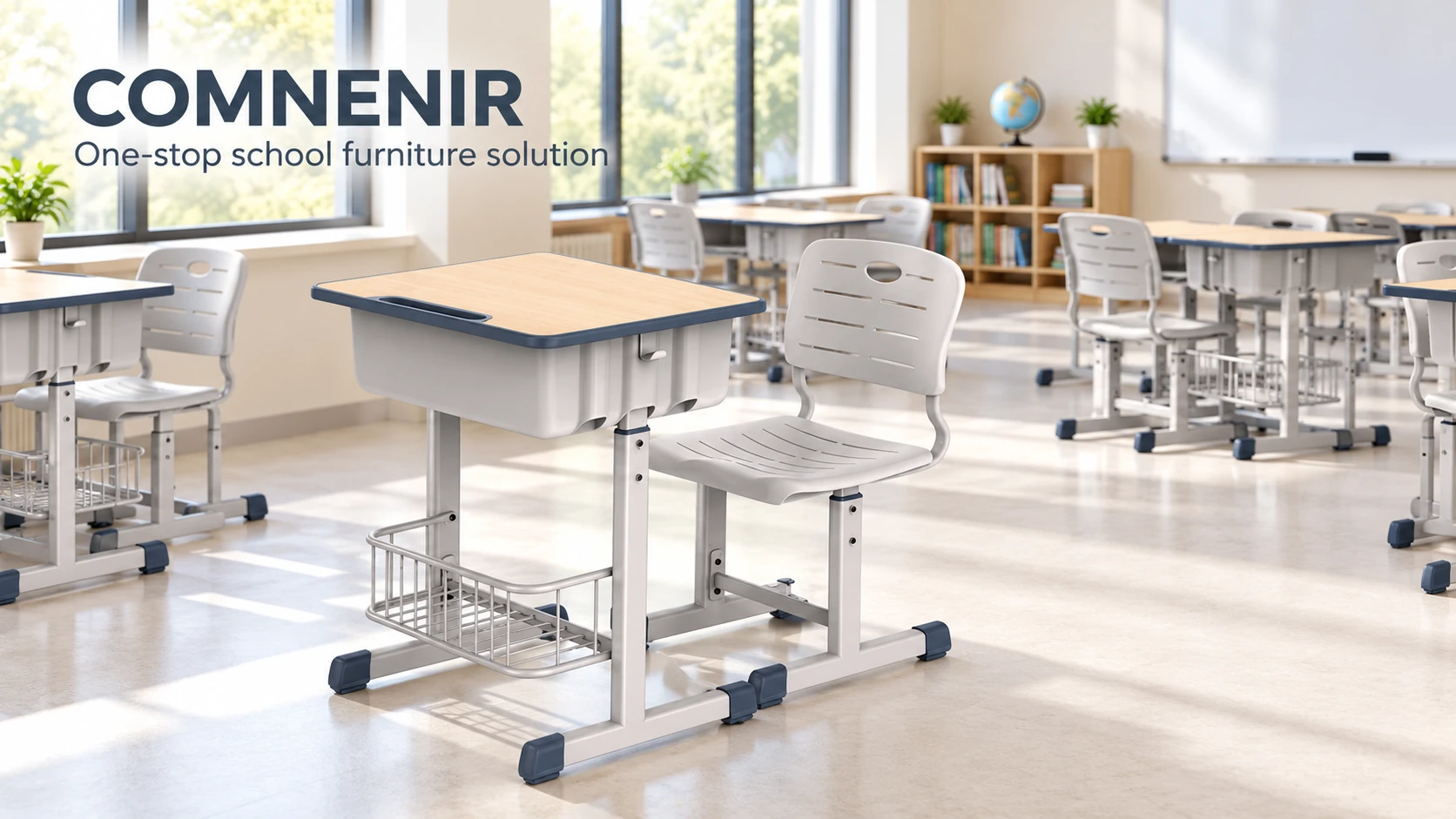
*By COMNENIR — One-stop school furniture solution*
Choosing school furniture starts with a practical question: will these desks, chairs and tables meet the needs of the students and classrooms they are intended to serve?
For schools, furniture distributors and education project contractors, the answer involves more than appearance and unit price. Student fit, accessibility, maintenance, material performance and delivery planning all deserve attention.
Recent education developments provide useful context. In February 2026, the UK government announced a ten-year Education Estates Strategy emphasizing inclusive facilities and resilience to flooding and overheating. In August 2026, UNESCO’s International Institute for Educational Planning reported how extreme heat and waterlogging were affecting schools in Dhaka, Bangladesh. These developments suggest that furniture specifications should be considered alongside the wider learning environment. [UK Department for Education](https://www.gov.uk/government/news/10-year-plan-to-revitalise-schools-and-colleges-for-every-child), [UNESCO IIEP](https://www.iiep.unesco.org/en/articles/climate-risks-through-lens-dhakas-schools)
For international buyers, five priorities can help turn these concerns into a clear school furniture purchasing brief.
## 1. Choose School Desks and Chairs That Fit Students
Ergonomic school furniture begins with appropriate dimensions. A durable chair can still be unsuitable if its seat height or depth does not match the students using it.
Before requesting a quotation, define the intended student age groups, size ranges and classroom activities. Ask the school furniture manufacturer for seat heights, desk heights, usable worktop dimensions and legroom measurements.
During sample evaluation, check whether students can sit with supported feet, reach the work surface comfortably and change position without obstruction. Where a classroom serves different groups, multiple furniture sizes or height-adjustable models may be worth considering.
Adjustment mechanisms also need practical assessment. They should remain secure during use and be manageable for the staff responsible for setting them.
**Buyer takeaway:** Request a size schedule and evaluate samples with representative users before approving a bulk order.
## 2. Make Flexible Classroom Furniture Easy to Use
A classroom may accommodate individual study, teacher-led instruction and small-group work within the same day. Furniture should support those activities without making every transition difficult.
Depending on the teaching brief, suitable options may include:
– Individual school desks that combine into group arrangements.
– Classroom tables that staff can reposition safely.
– Stackable chairs with clearly stated stacking limits.
– Mobile storage units with appropriate locking mechanisms.
– Accessible workstations integrated into the classroom layout.
Evaluate these features in a realistic floor plan. A table that looks compact in a catalogue may restrict circulation once chairs, school bags and storage are added.
Movement should also be tested. Consider furniture weight, floor protection, noise and the stability of mobile units. Ask teachers to review sample layouts before approving a large order.
**Buyer takeaway:** Assess classroom furniture in the intended room layout, including occupied chairs, storage and circulation routes.
## 3. Specify Materials for the Actual School Environment
UNESCO’s August 2026 account of schools in Dhaka highlighted the effects of extreme heat and heavy rainfall on access and learning conditions. For furniture buyers, the practical implication is to include local environmental conditions in the purchasing specification. [UNESCO IIEP](https://www.iiep.unesco.org/en/articles/climate-risks-through-lens-dhakas-schools)
Furniture is one part of that planning. Schools also need appropriate building, ventilation, shading and flood-management measures.
For school desks, chairs and storage units, ask suppliers how the proposed materials and finishes perform under the expected conditions. Relevant questions include:
– How are metal components protected against corrosion?
– How are panel edges and joints protected from moisture?
– Which cleaning products are compatible with the surfaces?
– Can damaged feet, fittings or worktops be replaced?
– Is the product intended for indoor or outdoor use?
Avoid treating a material name as proof of performance. Request evidence for the finished product and its intended application.
**Buyer takeaway:** Describe the installation environment and cleaning routine when requesting material recommendations.
## 4. Assess Sustainable School Furniture Beyond the Label
Sustainable materials are part of current school procurement discussions. In January 2026, the Philippine Department of Education announced a planned February–March distribution of 144,081 student table-and-chair sets made from bamboo, alongside 3,235 teacher sets. The announcement connected furniture procurement with sustainability and support for local industry. [Philippine Department of Education](https://www.deped.gov.ph/2026/01/19/public-schools-tatanggap-ng-bamboo-made-desks-sa-pagpapatupad-ni-angara-ng-15-year-old-industry-policy/)
For global buyers, this is a reason to examine material choices carefully. Bamboo, timber, steel, plastics and composite panels each need assessment against the project’s requirements.
Ask for documentation supporting claims about responsible sourcing, recycled content, emissions or other environmental attributes. Check that the evidence covers the offered product and materials.
Repairability deserves equal attention. Replaceable components, available spare parts and clear maintenance instructions can help schools keep furniture in service.
A useful sustainability brief should address materials, expected service conditions, maintenance and end-of-life options.
**Buyer takeaway:** Compare documented environmental attributes alongside durability and repairability.
## 5. Compare Total Project Cost and Supplier Evidence
The lowest unit price does not always produce the lowest project cost. International school furniture orders can involve freight, import charges, assembly, installation and ongoing maintenance.
Compare quotations on a consistent basis:
**Total project cost = furniture + transport + import costs + installation + expected maintenance and replacement costs.**
When evaluating a school furniture manufacturer, request a defined specification, sample approval process, production schedule, packaging details, warranty terms and spare-parts policy.
For sourcing school furniture from China, buyers should also confirm the agreed delivery terms, shipment responsibilities and destination requirements. Production capacity becomes more useful when supported by a clear schedule for the actual order.
Test reports should identify the relevant model, materials, test methods and results. Any proposed substitution should be reviewed before production.
**Buyer takeaway:** Compare suppliers against the same specification and delivery scope.
## Bulk School Furniture Sourcing with COMNENIR
**COMNENIR — One-stop school furniture solution** is a school furniture manufacturer based in China, with a monthly production capacity of **20,000 sets**.
For schools, distributors and education project contractors, this capacity provides a starting point for discussing bulk school furniture procurement and phased delivery requirements.
The production schedule for an individual order should be confirmed according to the selected models, customization requirements, order volume and current factory workload. Buyers should also allow time for sample approval, transportation and installation when planning around a school opening date.
To prepare a project-specific quotation, provide:
– Student age groups and required furniture sizes.
– Product types and quantities.
– Classroom dimensions or floor plans.
– Material, finish and color preferences.
– Applicable procurement and testing requirements.
– Delivery destination and target arrival date.
– Assembly and installation requirements.
A detailed brief helps COMNENIR understand the project and gives buyers a clearer basis for reviewing the proposed specifications, pricing and schedule.
## Frequently Asked Questions About School Furniture
### What should schools check before buying classroom furniture?
Start with student dimensions, room layouts, teaching activities, accessibility and destination requirements. Then evaluate samples, product evidence, maintenance needs and delivery timing.
### Is height-adjustable school furniture suitable for every classroom?
Its value depends on the users and how the room operates. Shared classrooms may benefit from adjustment, while other projects may be better served by several clearly identified fixed sizes.
### What makes school furniture sustainable?
Look for supported material claims, suitable durability, repairable components and practical maintenance. Assess the complete product over its expected use.
### What should buyers request from a school furniture manufacturer?
Request detailed specifications, relevant test reports, samples, production timelines, packaging information, warranty terms and spare-parts arrangements. Confirm that the documentation applies to the products being ordered.
### What is COMNENIR’s monthly production capacity?
COMNENIR has a monthly production capacity of 20,000 sets. Availability and lead times for a specific order should be confirmed according to its product specifications, quantity and the current production schedule.
### What information is needed for a bulk school furniture quotation?
Provide quantities, student age groups, dimensions, material preferences, room plans, delivery destination, required arrival date and applicable procurement specifications.
## Plan Your School Furniture Project with COMNENIR
Recent school investment and climate-related developments underline the value of planning classrooms as complete working environments.
For furniture procurement, that means choosing products around students, space, local conditions and long-term use. Clear specifications and early sample evaluation give buyers a stronger basis for comparing suppliers and preparing an order.
Whether you are furnishing a new campus, refurbishing classrooms or planning a school furniture distribution project, COMNENIR welcomes your project requirements.
**Contact COMNENIR — One-stop school furniture solution — with your furniture quantities, student age groups, room layouts and delivery destination to request a project-specific quotation.**
 Русский
 English