
A school furniture quotation can look straightforward: a model, a quantity and a unit price. Yet the real value of a school desk and bench set becomes clear only after it reaches the classroom. Does it fit the students? Can staff maintain it? Will the supplied specification match the approved sample?
These questions connect with a wider education discussion. On September 17, 2026, UNESCO published guidance on a whole-institution approach to education for sustainable development, covering school operations and decision-making alongside teaching and learning. For furniture buyers, a practical application of that approach is to consider how products will be selected, used, maintained and eventually replaced. [UNESCO’s guidance](https://www.unesco.org/en/articles/driving-sustainability-education-through-whole-institution-approach)
For schools, distributors and education project contractors, school desk and bench sets deserve a purchasing process that looks beyond the initial price.
## Define the Set Before Comparing Prices
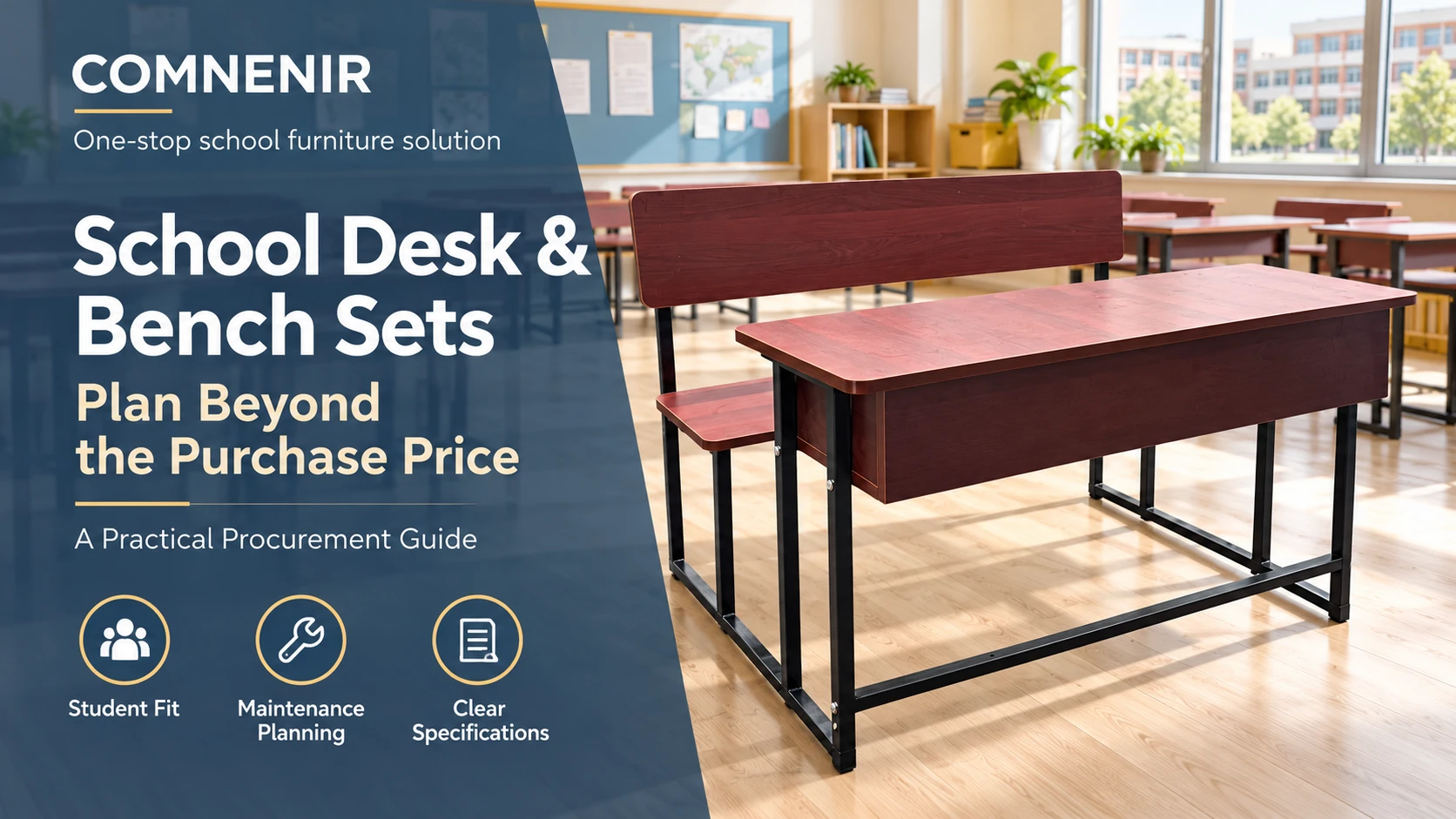
A desk-and-bench arrangement combines a shared writing surface with continuous bench seating. The COMNENIR product shown here features red-brown woodgrain surfaces, a long bench backrest and a black metal frame.
Start by confirming exactly what the supplier means by one set. Establish whether the quotation includes the desk, bench, backrest, assembly hardware and protective foot components. Ask for the intended seating capacity and a dimensioned drawing rather than estimating capacity from a photograph.
This makes comparisons more useful. Two quotations are comparable only when their contents, specifications and delivery terms are clear.
## Put Student Fit Ahead of Seating Count
A long desktop does not automatically provide suitable space for every student group. Desk height, bench height, seat depth and the distance between the seat and writing surface all matter.
For fixed-height furniture, select dimensions for the intended users. A bench also provides less individual positioning freedom than separate chairs, so review how students will enter, leave and use the seating during a normal lesson.
Where practical, evaluate a sample with representative users and school staff. Include accessible seating arrangements in the classroom plan so that different learner needs are accommodated.
## Specify Materials Beyond the Woodgrain Finish
A woodgrain appearance describes the finish, not the underlying material. Ask the manufacturer to identify the desktop, seat and backrest substrate, panel thickness, surface treatment and edge construction.
For the metal frame, confirm the section dimensions, wall thickness, coating and connection details. These specifications help establish a consistent basis for sampling, production and inspection.
If a project requires material-emission reports, strength testing or responsible-sourcing documentation, request evidence covering the actual product and materials ordered. Appearance alone cannot establish those properties.
## Include Maintenance in the Buying Decision
Ask a simple question before placing a bulk order: what happens when a component needs attention?
Confirm which parts can be replaced, what tools are required and whether replacement panels, hardware or foot components will remain available. Request cleaning instructions that match the supplied surface and coating.
Maintenance planning can help schools avoid replacing an entire set for a repairable problem. However, the benefit depends on the product’s construction, spare-part availability and the school’s ability to carry out repairs.
## Compare the Cost of Getting Furniture into Use
The quoted unit price is only one part of the project budget. Buyers should also account for packing, freight, import charges, inland transport, assembly and any agreed spare parts.
Compare quotations using the same trade terms and destination assumptions. For example, an EXW quotation needs additional logistics costs before it can be compared fairly with a delivered offer.
Ask for packing dimensions, gross weight and assembly requirements early. These details help distributors and project contractors plan transport, storage and installation more accurately.
## Turn the Approved Sample into a Clear Order
Before production begins, record the approved dimensions, materials, colours, construction details and packing method. Agree on inspection requirements, quantity checks and how any differences from the approved specification will be handled.
For multi-school projects, identify quantities by delivery location. Clear labelling and a coordinated receiving schedule can make distribution easier when furniture arrives.
## Plan Your School Furniture Project with COMNENIR
COMNENIR — One-stop school furniture solution — is a China-based school furniture manufacturer with a monthly production capacity of 20,000 sets.
Whether you are sourcing classroom furniture for a school, distribution business or education project, share your student age range, required quantities, destination and technical requirements with COMNENIR. These details provide the basis for a suitable product proposal and an order-specific quotation.
A well-planned school desk and bench purchase begins with a clear specification and continues through delivery, daily use and maintenance. Choosing on that basis gives buyers a stronger foundation for evaluating long-term value.
 Русский
 English