
Why Classroom Planning Matters in the Latest Education Debate
Supporting teachers is a central education issue in October 2026. On October 5, the UNESCO Institute for Statistics reported that the world needs another 50 million teachers by 2030 to achieve universal access to pre-primary, primary and secondary education. The announcement highlights the need to support the teaching profession and improve working conditions. Source: UNESCO Institute for Statistics
For school leaders and procurement teams, this broader discussion also raises a practical question: does the classroom make everyday teaching easier?
Furniture is one part of that environment. A useful purchasing decision considers how teachers reach students, how learners use their workspace, and how the room accommodates different activities. These are practical implications for classroom planning, rather than findings that the UNESCO announcement makes about a particular desk design.
Double school desks can be a suitable option when two students need a shared work surface and the room can accommodate the desk footprint, chairs and circulation space.
What Is a Double School Desk?
A double school desk is a classroom desk designed for two students seated side by side. It generally combines one shared desktop with two chairs, although suppliers may price the desk and chairs separately.
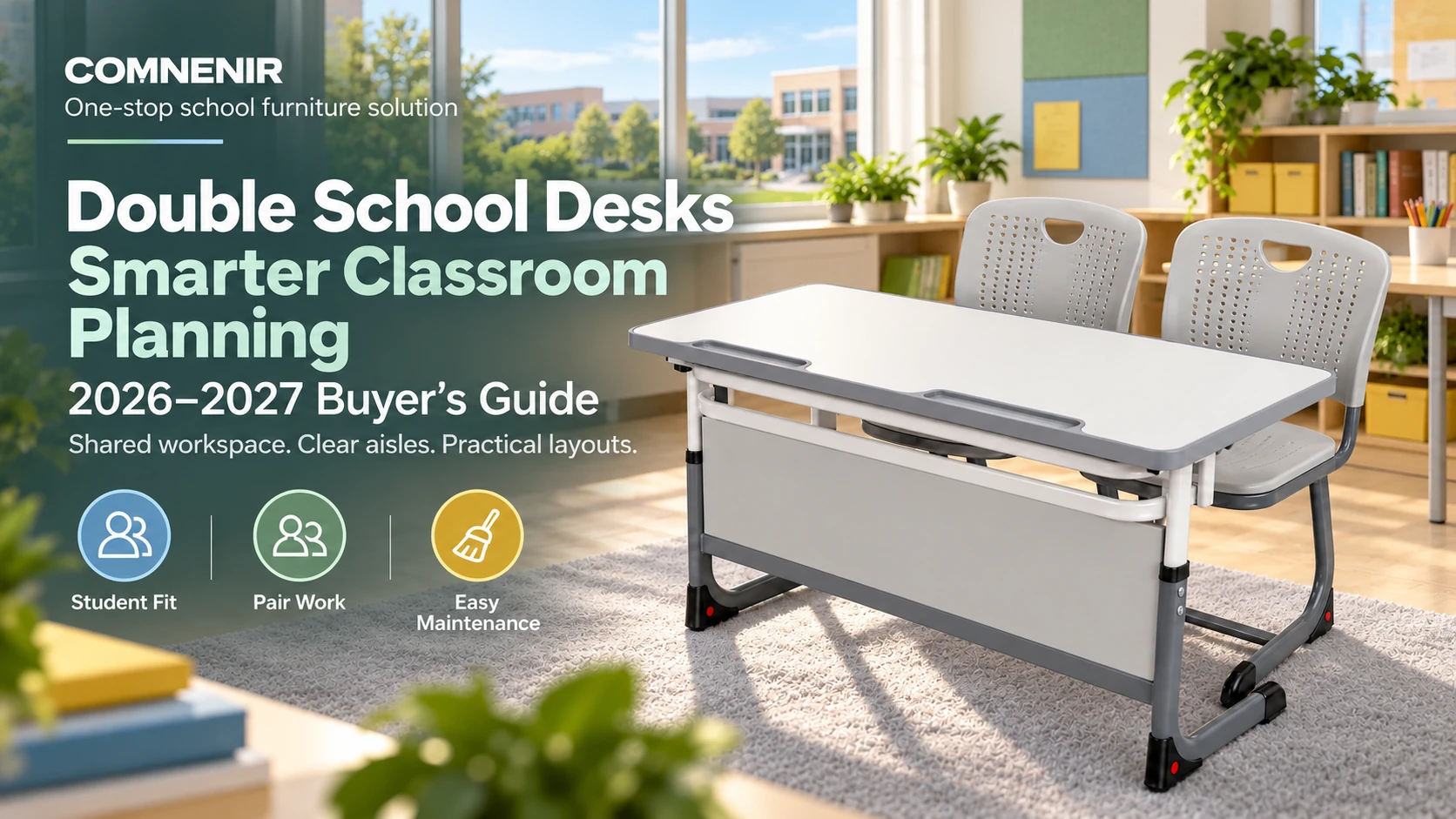
The COMNENIR product pictured with this article features a shared grey desktop with two pencil grooves, a front modesty panel and two matching chairs with perforated backrests. Buyers should confirm the model’s dimensions, available height settings, materials and order configuration before choosing it for a project.
1. Start with Student Fit
Choose furniture around the learners who will use it. Student age alone is not enough: body size, desk height, seat height and clearance beneath the desktop all affect suitability.
Ask for a dimensioned drawing and a physical sample where practical. During the sample review, check whether students can sit with their feet supported, use the work surface comfortably and move their chairs without obstruction.
If the selected model has adjustable heights, confirm the adjustment range and locking method. Visible adjustment features do not establish that every setting suits every learner.
2. Plan Teacher Access and Clear Circulation
Double desks create a defined two-student workspace, but the classroom layout determines whether that arrangement is practical.
Draw the proposed layout using the actual desk and chair dimensions. Include occupied chairs, entrance routes, storage, teaching equipment and the space teachers need to move between students. Check visibility of the teaching area from each seat and account for accessibility requirements.
For example, 30 students would require 15 double desks and 30 chairs if each desk seats two. That calculation is only a starting point: room dimensions, local requirements and student needs determine whether the arrangement is suitable.
3. Balance Pair Work with Individual Tasks
A shared desktop can accommodate activities such as discussing a worksheet, reading together or comparing written answers. It should also provide sufficient personal space for independent work.
Before purchasing, test the proposed desktop with the books, exercise materials and devices students normally use. Check whether two learners can work simultaneously without competing for writing space.
Teachers should help review the sample layout. Their feedback can reveal practical issues that a product photograph or seating count cannot show.
4. Review Maintenance Before Placing a Bulk Order
School furniture faces repeated daily use. Procurement teams should inspect edge finishing, frame connections, foot caps, surface cleaning requirements and the availability of replacement parts.
Ask suppliers for written care instructions and warranty terms. Where testing or certification is required, verify that the documentation covers the exact model and specification being ordered.
Compare the full purchase package, including chairs, packing, spare parts and delivery terms. A lower desk-only price may not represent a lower project cost.
5. Make the Quotation Precise
A clear school furniture inquiry should include:
Student age range and intended use.
Required desk and chair quantities.
Room dimensions or a proposed layout.
Preferred dimensions, colours and height options.
Destination country, delivery location and target schedule.
Applicable tender specifications and documentation requirements.
Define the word “set” explicitly. For a double-desk project, confirm whether one set means one desk plus two chairs, and whether accessories or spare parts are included.
Planning Your Next School Furniture Project with COMNENIR
COMNENIR — One-stop school furniture solution — is a China-based school furniture manufacturer with a monthly production capacity of 20,000 sets.
For project planning, distinguish production capacity from the lead time for your specific order. Final scheduling depends on the confirmed configuration, quantity, production availability and shipping arrangements.
Send COMNENIR your student age range, furniture quantities, destination and project requirements to request a product recommendation and quotation. A detailed inquiry helps align the selected double school desk and chair configuration with the classroom’s actual needs.
Frequently Asked Questions
Are double school desks suitable for every classroom?
Suitability depends on student fit, room dimensions, circulation, accessibility and teaching activities. Review a scaled layout and sample before making a bulk purchase.
Does one double school desk set include two chairs?
It can, but quotation conventions vary. Ask the supplier to list the desk, chair quantity and included accessories explicitly.
Can double desks support collaborative learning?
They provide a shared surface for two students. How effectively that surface is used depends on the task, available space and teaching approach.
What should overseas buyers confirm before ordering?
Confirm dimensions, materials, height options, applicable documentation, packing, warranty, trade terms and the agreed delivery schedule.
 Русский
 English